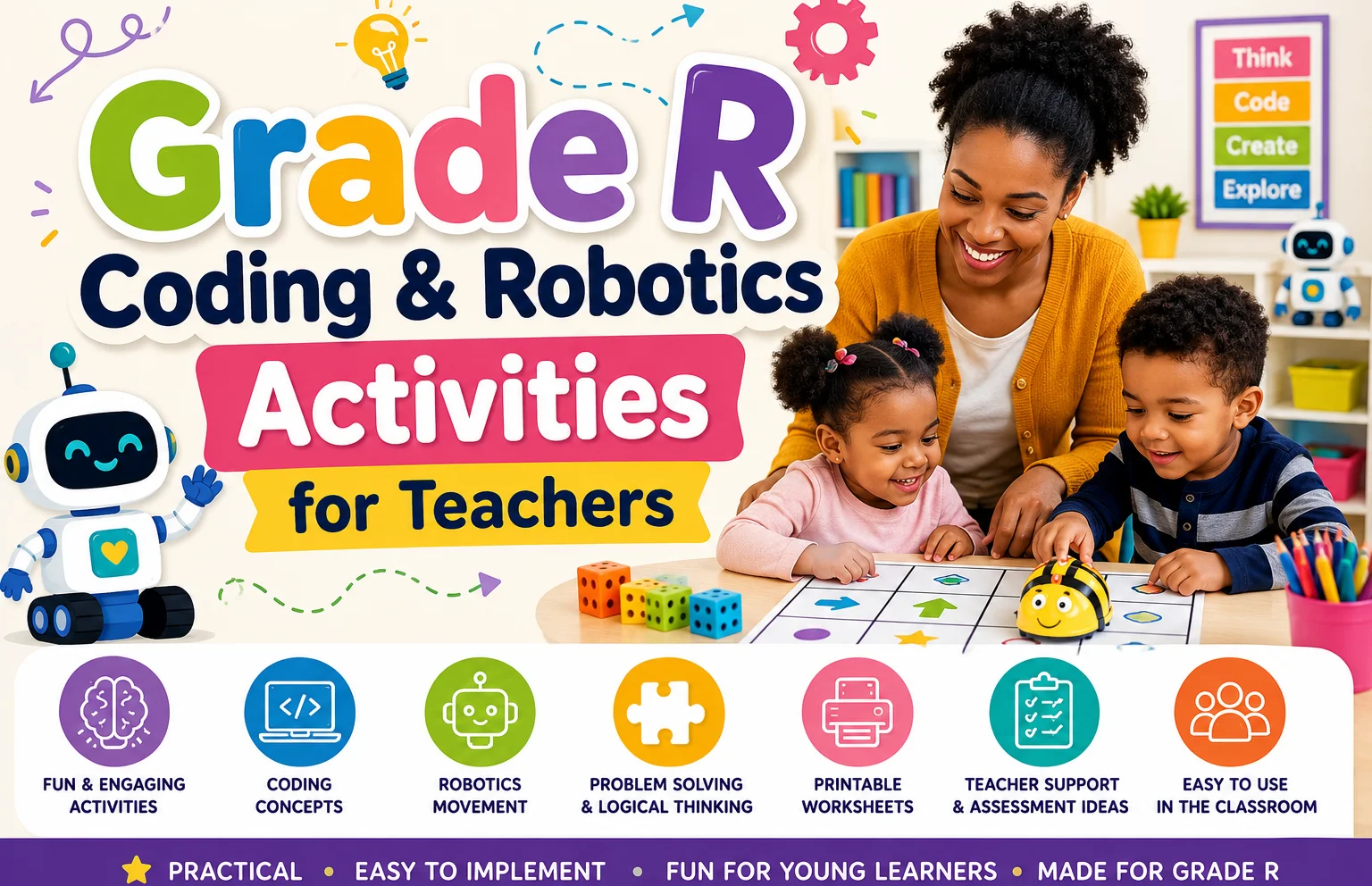
Grade R Coding and Robotics Activities for Teachers
Categories: Foundation Phase
Wishlist Share

About Course

Grade R Coding and Robotics Activities for Teachers is a practical, hands-on professional development course designed to help educators confidently introduce coding and robotics concepts to young learners. The course provides a collection of fun, age-appropriate activities that develop problem-solving, critical thinking, creativity, pattern recognition, sequencing, and computational thinking skills in Grade R classrooms.

Teachers will learn how to deliver engaging lessons using play-based learning, storytelling, movement activities, games, crafts, and unplugged coding exercises that require little or no technology. The course also explores introductory robotics concepts, digital literacy, internet safety, and effective classroom strategies for teaching coding and robotics in the Foundation Phase.

Course Highlights

  • ✅ Practical Classroom Activities – Access a wide range of ready-to-use coding and robotics activities designed specifically for Grade R learners.

    ✅ Play-Based Learning Approach – Teach coding concepts through games, storytelling, movement, songs, crafts, and hands-on exploration.

    ✅ Unplugged Coding Lessons – Learn how to introduce coding without computers using engaging, low-cost classroom resources.

    ✅ Robotics Foundations – Explore basic robotics concepts, robot design activities, and beginner-friendly robotics challenges for young children.

    ✅ CAPS-Aligned Strategies – Understand how coding and robotics fit within the Foundation Phase curriculum and learning outcomes.

    ✅ Lesson Planning Support – Receive guidance on creating effective lesson plans, classroom activities, and learner assessments.

    ✅ Printable Teaching Resources – Gain access to worksheets, flashcards, activity templates, checklists, and assessment tools.

    ✅ Computational Thinking Skills – Help learners develop problem-solving, logical thinking, sequencing, and pattern recognition skills.

    ✅ Digital Literacy and Online Safety – Introduce young learners to responsible technology use and basic internet safety concepts.

    ✅ Professional Development Certificate – Earn a Certificate of Completion to showcase your commitment to innovative teaching practices.

    🎓 Ideal for: Grade R Teachers, Foundation Phase Educators, ECD Practitioners, Teacher Assistants, Homeschool Educators, and Parents interested in coding and robotics education.

Whether you are new to coding and robotics or looking for fresh classroom ideas, this course offers ready-to-use activities, lesson planning guidance, assessment tools, and practical resources to support successful implementation in early childhood education settings.

By the end of the course, participants will be able to design and facilitate exciting coding and robotics experiences that inspire curiosity, build confidence, and prepare young learners for a technology-driven future.

Show More

What Will You Learn?

  • Understand the CAPS Grade R Coding and Robotics curriculum.
  • Explain computational thinking using child-friendly methods.
  • Teach pattern recognition and problem-solving activities.
  • Introduce algorithms and sequencing through play-based learning.
  • Facilitate engaging unplugged coding activities.
  • Teach basic robotics skills using age-appropriate resources.
  • Promote internet safety and digital awareness.
  • Plan effective Coding and Robotics lessons.
  • Assess learner progress using simple assessment strategies.
  • Create fun classroom activities that develop critical thinking and creativity.
  • Build confidence in teaching Coding and Robotics.
  • Integrate Coding and Robotics into daily classroom teaching.

Course Content

Module 1: Introduction to Grade R Coding and Robotics
This module introduces teachers to the exciting world of Coding and Robotics in Grade R. Participants will explore what coding and robotics are, why they are important in early childhood education, and how they support the development of problem-solving, creativity, communication, collaboration, and critical thinking skills. The module also explains the purpose of the CAPS Coding and Robotics curriculum, its key learning areas, and the teacher's role in creating engaging, play-based learning experiences. By the end of this module, teachers will have a clear understanding of the foundations of Grade R Coding and Robotics and will be ready to confidently teach young learners. Learning Outcomes By the end of this module, you will be able to: Explain what Coding and Robotics means in Grade R. Understand the importance of Coding and Robotics in early childhood development. Identify the key components of the CAPS Grade R Coding and Robotics curriculum. Recognize the role of computational thinking in young learners. Describe the teacher's role in facilitating Coding and Robotics lessons. Prepare for the practical activities covered in the following modules.

  • What is Coding?
  • What is Robotics?
  • Why Teach Coding and Robotics in Grade R?
  • Computational Thinking for Young Learners
  • Activity: Design a Simple Classroom Coding Corner

Module 2: Pattern Recognition and Problem Solving
In this module, teachers explore the foundation of computational thinking through pattern recognition and problem-solving. They will learn how young children identify, compare, and extend patterns using colours, shapes, objects, sounds, movements, and everyday experiences. The module demonstrates how pattern activities develop logical thinking, observation, prediction, and reasoning skills while preparing learners for future coding concepts. Teachers will also discover practical, play-based strategies that align with the Grade R Coding and Robotics Curriculum, making learning enjoyable, meaningful, and age-appropriate. Learning Outcomes By the end of this module, you will be able to: Explain the importance of pattern recognition in early childhood learning. Identify different types of patterns suitable for Grade R learners. Teach learners how to recognize, copy, complete, and create simple repeating patterns. Use play-based activities to strengthen problem-solving skills. Encourage learners to observe, compare, predict, and explain patterns. Apply aligned teaching strategies for pattern recognition and problem solving.

Module 3: Algorithms and Sequencing
In this module, teachers learn how to introduce algorithms and sequencing to Grade R learners through fun, practical, and play-based activities. Teachers will discover that an algorithm is simply a set of step-by-step instructions used to complete a task or solve a problem. Learners will practice following, creating, and arranging sequences using everyday classroom routines, stories, movement activities, pictures, and games. These activities build logical thinking, planning, communication, and computational thinking skills while preparing learners for future coding experiences. All activities are aligned with the CAPS Grade R Coding and Robotics Curriculum and are designed to be engaging, age-appropriate, and easy to implement. Learning Outcomes By the end of this module, you will be able to: Explain what an algorithm is in simple, child-friendly language. Teach learners how to follow and create simple step-by-step instructions. Help learners arrange events and actions in the correct sequence. Use everyday classroom activities to introduce sequencing concepts. Develop learners' planning, logical thinking, and problem-solving skills. Apply CAPS-aligned teaching strategies for algorithms and sequencing.

Module 4: Unplugged Coding Activities
In this module, teachers explore unplugged coding activities that introduce coding concepts without the use of computers or digital devices. Through games, stories, songs, movement, role-play, puzzles, and hands-on activities, learners develop computational thinking, problem-solving, communication, and teamwork skills in a fun and engaging way. Teachers will learn how to create meaningful learning experiences that help Grade R learners understand coding concepts through play while meeting the requirements of the CAPS Grade R Coding and Robotics Curriculum. Learning Outcomes By the end of this module, you will be able to: Explain what unplugged coding activities are and why they are important. Plan and facilitate fun, play-based coding activities without technology. Teach learners coding concepts through movement, games, stories, and role-play. Develop learners' computational thinking, sequencing, and problem-solving skills. Encourage collaboration, creativity, and communication through group activities. Apply aligned unplugged coding strategies in the Grade R classroom.

Module 5: Robotics Skills for Grade R
In this module, teachers are introduced to the fundamentals of robotics in the Grade R classroom. They will learn how to use age-appropriate educational robots and hands-on activities to develop learners' understanding of movement, direction, sequencing, and problem-solving. Through play-based learning, children will practice giving and following simple commands, exploring directional language, and understanding how robots respond to instructions. Teachers will gain practical strategies for planning engaging robotics lessons that are safe, inclusive, and aligned with the CAPS Grade R Coding and Robotics Curriculum. Learning Outcomes By the end of this module, you will be able to: Explain the basic concepts of robotics for Grade R learners. Identify and use age-appropriate educational robots and robotics resources. Teach learners how to give and follow simple robot commands. Introduce directional language such as forward, backward, left, right, stop, and turn. Facilitate hands-on robotics activities that promote problem-solving and teamwork. Apply CAPS-aligned teaching strategies for robotics in the Grade R classroom.

Module 6: Internet and Digital Awareness
In this module, teachers learn how to introduce internet and digital awareness to Grade R learners in a safe, simple, and age-appropriate way. The focus is on helping young children understand that digital devices can be used for learning, communication, and creativity while developing good digital habits from an early age. Teachers will explore basic online safety, responsible use of technology, protecting personal information, and encouraging learners to seek adult guidance when using the internet. All activities are designed to be play-based, practical, and aligned with the CAPS Grade R Coding and Robotics Curriculum. Learning Outcomes By the end of this module, you will be able to: Explain the purpose of the internet in a way that Grade R learners can understand. Teach learners how to use digital devices safely and responsibly. Introduce basic online safety rules and digital citizenship. Help learners recognize trusted adults who can assist with technology. Promote responsible behaviour when using digital tools and online resources. Apply CAPS-aligned strategies for teaching internet and digital awareness in Grade R.

Module 7: Application Skills
# Module 7 Summary: Application Skills Congratulations on completing **Module 7: Application Skills**. In this module, you explored practical ways to integrate digital tools into Coding & Robotics lessons. You learned how educational apps can make learning more engaging, interactive, and learner-centered while supporting the development of problem-solving, creativity, communication, and digital literacy skills. You discovered a variety of drawing and creativity tools that allow learners to express ideas visually, create digital artwork, and design simple coding-related projects. These tools encourage innovation while helping learners build confidence with technology. You also examined interactive learning activities that promote collaboration, critical thinking, and active participation. Through games, quizzes, simulations, and digital challenges, learners can strengthen their understanding of coding concepts in a fun and meaningful way. Finally, you practiced planning and facilitating hands-on classroom activities that combine digital resources with practical learning experiences. These activities help learners apply computational thinking and coding skills to real-world situations while keeping lessons engaging and inclusive. ### Key Takeaways * Use educational apps to enhance teaching and learner engagement. * Integrate digital drawing and creativity tools into classroom projects. * Design interactive learning activities that reinforce coding concepts. * Plan practical, hands-on lessons that encourage collaboration and problem-solving. * Select age-appropriate digital resources that support curriculum objectives. * Build learners' confidence in using technology safely, creatively, and responsibly. You are now prepared to use a wide range of digital tools and practical teaching strategies to create engaging Coding & Robotics lessons that inspire creativity, collaboration, and lifelong learning.

Module 8: Lesson Planning and Assessment
# Module 8 Summary: Lesson Planning and Assessment Congratulations on completing **Module 8: Lesson Planning and Assessment**. In this module, you learned how to design effective Coding & Robotics lessons that are engaging, learner-centered, and aligned with curriculum outcomes. Careful lesson planning ensures that every activity has a clear purpose and helps learners progressively develop computational thinking, coding, and problem-solving skills. You explored a variety of assessment methods suitable for young learners, focusing on continuous, practical, and developmentally appropriate assessment rather than formal testing. By using observations, questioning, demonstrations, and learner projects, teachers can accurately monitor progress while encouraging confidence and participation. You also learned how to use observation checklists to record learners' skills, participation, collaboration, creativity, and understanding during classroom activities. These tools provide valuable evidence of learning and help teachers identify learners who may need additional support. Finally, you examined classroom management strategies that create a safe, organized, and inclusive learning environment. Effective routines, clear instructions, positive reinforcement, and well-managed practical activities help learners stay focused, work collaboratively, and enjoy Coding & Robotics lessons. ### Key Takeaways * Plan structured Coding & Robotics lessons with clear learning objectives. * Use age-appropriate assessment strategies to monitor learner progress. * Apply observation checklists to assess practical skills and participation. * Create a positive classroom environment that supports active learning. * Differentiate instruction to meet the diverse needs of learners. * Encourage creativity, collaboration, and problem-solving through practical activities. * Reflect on lesson effectiveness to continuously improve teaching practice. By completing this module, you have developed the knowledge and practical skills needed to confidently plan, teach, assess, and manage engaging Coding & Robotics lessons. You are now equipped to create meaningful learning experiences that inspire curiosity, creativity, and critical thinking in young learners.

Final Examination Grade R Coding and Robotics Activities for Teachers

Conclusion

Student Ratings & Reviews

No Review Yet
No Review Yet