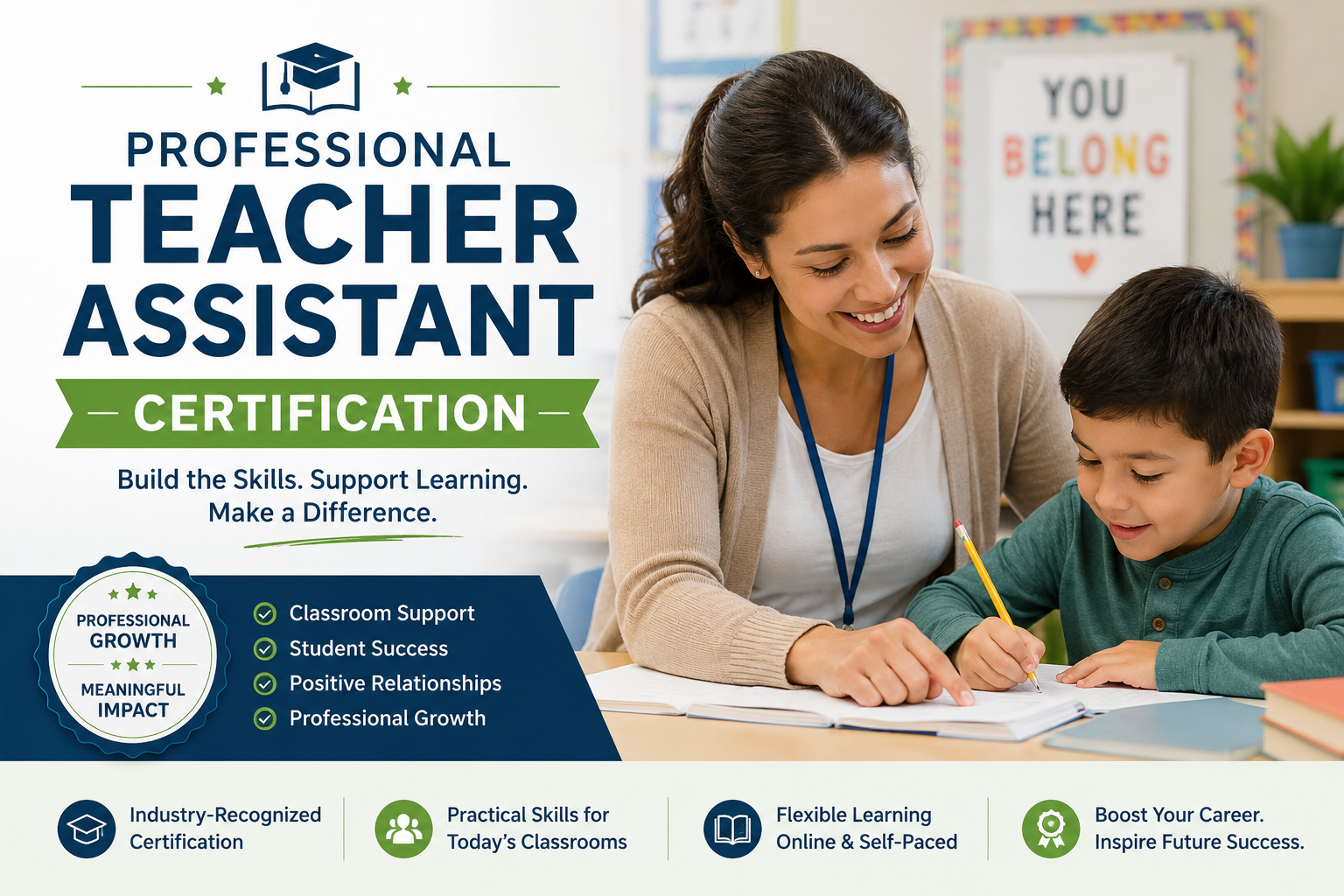
Professional Teacher Assistant Certification : Practical Classroom Skills for Modern Education Support Professionals
Wishlist Share

About Course

Launch your career in education with this comprehensive and practical certification program designed for aspiring teacher assistants, classroom aides, and education support professionals.

This course equips you with the essential knowledge, skills, and confidence needed to support teachers and learners in modern primary and secondary school environments. You will develop expertise in classroom management, positive discipline strategies, lesson support, learner supervision, educational technology, and administrative responsibilities.

You will also gain valuable insight into inclusive education practices, including supporting learners with ADHD, autism, dyslexia, and other special educational needs. Through practical assignments, case studies, classroom-based activities, and professional portfolio development, you will learn how to contribute effectively to student success and school operations.

By the end of this course, you will be able to:
• Support teachers in delivering engaging lessons.
• Assist with classroom management and learner supervision.
• Apply positive behaviour and discipline strategies.
• Support learners with diverse educational needs.
• Maintain professional communication with teachers and parents.
• Use educational technology and classroom management tools.
• Prepare professional reports, records, and documentation.
• Build a portfolio demonstrating your readiness for employment.

Upon successful completion of the course and final assessment, learners will receive a Professional Teacher Assistant Certification from JoeComm Edification.

Whether you are seeking employment in schools, preparing for a career in education, or looking to enhance your classroom support skills, this certification provides a strong foundation for success in today’s educational environment.

.

  • • ✅ Comprehensive Training Program – Complete 6 structured learning phases covering educational foundations, child development, classroom management, inclusive education, learner support, and professional workplace skills.

    • ✅ Inclusive Education & SEND Support – Develop practical strategies for supporting learners with ADHD, Autism Spectrum Disorder (ASD), Dyslexia, and other diverse learning needs.

    • ✅ Practical Classroom Resources – Access downloadable templates, observation forms, progress-tracking tools, communication logs, and classroom management resources designed for real school environments.

    • ✅ Flexible Online Learning – Study anytime, anywhere with self-paced lessons, practical activities, case studies, quizzes, and assessment tasks that fit your schedule.

    • ✅ Industry-Relevant Skills – Gain classroom-ready knowledge and professional skills aligned with modern educational practices and the expectations of schools worldwide.

    • ✅ Professional Portfolio Development – Build a professional portfolio showcasing your assignments, practical activities, and evidence of learning to support future employment opportunities.

    • ✅ Certification Upon Completion – Receive a Professional Teacher Assistant Certificate from JoeComm Edification upon successfully completing all course requirements and the final assessment..

 
Show More

What Will You Learn?

  • Understand the roles and responsibilities of a professional Teacher Assistant.
  • Support teachers in delivering engaging and effective classroom instruction.
  • Apply classroom management and positive behaviour support strategies.
  • Assist learners through small-group instruction and targeted interventions.
  • Adapt learning activities for diverse learning abilities and inclusive classrooms.
  • Support learners with ADHD, Autism, Dyslexia, and other special educational needs (SEND).
  • Use educational technology, smartboards, grading systems, and Learning Management Systems (LMS).
  • Assist with classroom administration, lesson preparation, and resource management.
  • Monitor learner progress and maintain accurate educational records.
  • Communicate professionally with teachers, parents, and school staff.
  • Develop a professional teaching portfolio for employment opportunities.
  • Gain practical classroom skills that prepare you for work in schools worldwide.

Course Content

Section 1: Foundations of Education & Assistant Roles

  • Lesson 1.1: The Modern Teacher Assistant: Roles, Boundaries, and Ethics
  • Lesson 1.2: Introduction to Child Development Stages (Ages 5 to 18)

Section 2: Classroom Management & Supervision
Module Summary: Section 2 – Classroom Management & Supervision In this section, you explored practical strategies for creating a well-organized, engaging, and positive learning environment. You learned how effective classroom layouts and learning stations support collaboration, independence, and active participation. You also discovered the importance of establishing consistent routines and managing transitions efficiently to maximize instructional time and minimize disruptions. Finally, you examined positive discipline approaches and de-escalation techniques that help build respectful relationships, manage challenging behaviours calmly, and promote a safe, inclusive classroom where all learners can thrive. Key Takeaways: Design classroom layouts that encourage learning, movement, and collaboration. Create effective learning stations that support differentiated instruction. Establish clear routines and smooth transitions to improve classroom efficiency. Apply positive discipline strategies that encourage responsible behaviour. Use de-escalation techniques to resolve conflicts calmly and respectfully. Foster a safe, supportive, and learner-centred classroom environment.

Section 3: Instructional & Lesson Support
Module Summary: Section 3 – Instructional & Lesson Support In this section, you developed the skills needed to effectively support teaching and learning in diverse classroom settings. You explored strategies for leading small groups, facilitating reading circles, and conducting targeted review sessions that reinforce learner understanding. You also learned how to differentiate instruction by adapting lessons, resources, and activities to meet the varying abilities, learning styles, and needs of all learners. Finally, you examined how educational technology—including smartboards, grading portals, and Learning Management Systems (LMS)—can enhance instruction, improve communication, and streamline classroom management. The section concludes with a practical assignment where you apply differentiation strategies by adjusting an existing lesson plan to support learners with different abilities. **Key Takeaways:** * Lead effective small-group instruction and reading circles. * Facilitate targeted review sessions to reinforce key concepts. * Differentiate lessons to accommodate diverse learning needs and abilities. * Modify instructional materials, activities, and assessments for inclusive learning. * Integrate educational technology to enhance teaching and learner engagement. * Use smartboards, grading portals, and LMS platforms to improve classroom efficiency. * Apply differentiated instruction by adapting a lesson plan for varied learner capabilities.

Section 4 – Inclusive Education & Special Needs (SEND)
Module Summary: Section 4 – Inclusive Education & Special Needs (SEND) In this section, you explored the principles of inclusive education and gained practical strategies for supporting learners with diverse educational needs. You learned about neurodiversity, including the characteristics and classroom needs of learners with ADHD, autism, and dyslexia. You also examined how accommodations, visual supports, and assistive technologies can improve accessibility and learner participation. Finally, you developed an understanding of Individual Education Plans (IEPs), including how to monitor learner progress, document interventions, and maintain compliance with school policies while working collaboratively with teachers, parents, and support professionals. **Key Takeaways:** * Understand the foundations of inclusive education and neurodiversity. * Recognize the characteristics and learning needs of learners with ADHD, autism, and dyslexia. * Implement appropriate classroom accommodations and modifications. * Use visual supports and assistive technology to enhance learner success. * Support learners through individualized instruction and inclusive teaching practices. * Monitor learner progress and contribute to the implementation of Individual Education Plans (IEPs). * Collaborate effectively with teachers, parents, and support specialists to promote inclusive learning environments.

Section 5: Administrative Support & Assessment
Module Summary: Section 5 – Administrative Support & Assessment In this section, you developed the administrative and assessment skills needed to support an efficient and well-organized classroom. You learned how to manage classroom inventory, prepare learning materials, and organize lesson resources to ensure teaching runs smoothly. You also explored objective grading methods for spelling, mathematics, and automated assessments, emphasizing fairness, consistency, and accuracy. Finally, you practiced maintaining professional communication through clear documentation and progress reports for teachers and parents. The section concludes with a practical assignment where you create a mock parent progress report using professional and constructive language. Key Takeaways: Organize and manage classroom materials, inventory, and lesson preparation. Prepare learning resources to support effective classroom instruction. Apply objective and consistent grading practices across different assessment types. Record learner performance accurately using manual and digital assessment tools. Write clear, professional communication logs and learner progress reports. Communicate learner achievements and areas for improvement effectively with teachers and parents. Demonstrate administrative professionalism by completing a mock parent progress report.

Section 6: Practical Practicum & Portfolio
In this final section, you focused on applying your knowledge in a real classroom environment and preparing for professional employment. You learned how to secure and successfully complete your local in-school practicum by working alongside experienced educators, demonstrating professional conduct, and gaining practical teaching support experience. You also explored how to develop a well-organized professional portfolio that showcases your skills, practicum experiences, lesson resources, assessments, and professional achievements. Completing this section prepares you to confidently enter the education sector with evidence of your competencies and readiness to support teaching and learning. Key Takeaways: Secure and successfully complete a structured in-school practicum. Demonstrate professionalism, reliability, and ethical conduct in a classroom setting. Apply classroom management, instructional support, and administrative skills in a real educational environment. Reflect on practicum experiences to support continuous professional growth. Compile a comprehensive professional portfolio showcasing your knowledge, skills, and achievements. Organize evidence such as lesson plans, assessments, reports, certificates, and reflective journals. Prepare a professional portfolio that strengthens your employability and career opportunities as a Teacher Assistant.

Final Exam: Comprehensive Certification Evaluation
Final Exam: Comprehensive Certification Evaluation The Comprehensive Certification Evaluation is the final assessment for this course and is designed to measure your overall understanding of the knowledge and skills covered throughout all modules. The exam evaluates your ability to apply best practices in classroom support, learner supervision, instructional assistance, inclusive education, classroom administration, assessment, and professional conduct. Successfully completing this examination demonstrates that you are prepared to perform the responsibilities of a Teacher Assistant in a professional educational setting. Exam Outcomes: Demonstrate a comprehensive understanding of the Teacher Assistant role and responsibilities. Apply classroom management and learner supervision strategies effectively. Support instruction using differentiated teaching approaches and educational technology. Implement inclusive education practices for learners with diverse needs. Apply assessment, grading, and administrative procedures accurately. Communicate professionally with teachers, learners, and parents. Demonstrate readiness for employment as a competent and professional Teacher Assistant.

Student Ratings & Reviews

No Review Yet
No Review Yet