Coding and Robotics Education in Intermediate Phase
Wishlist Share

About Course

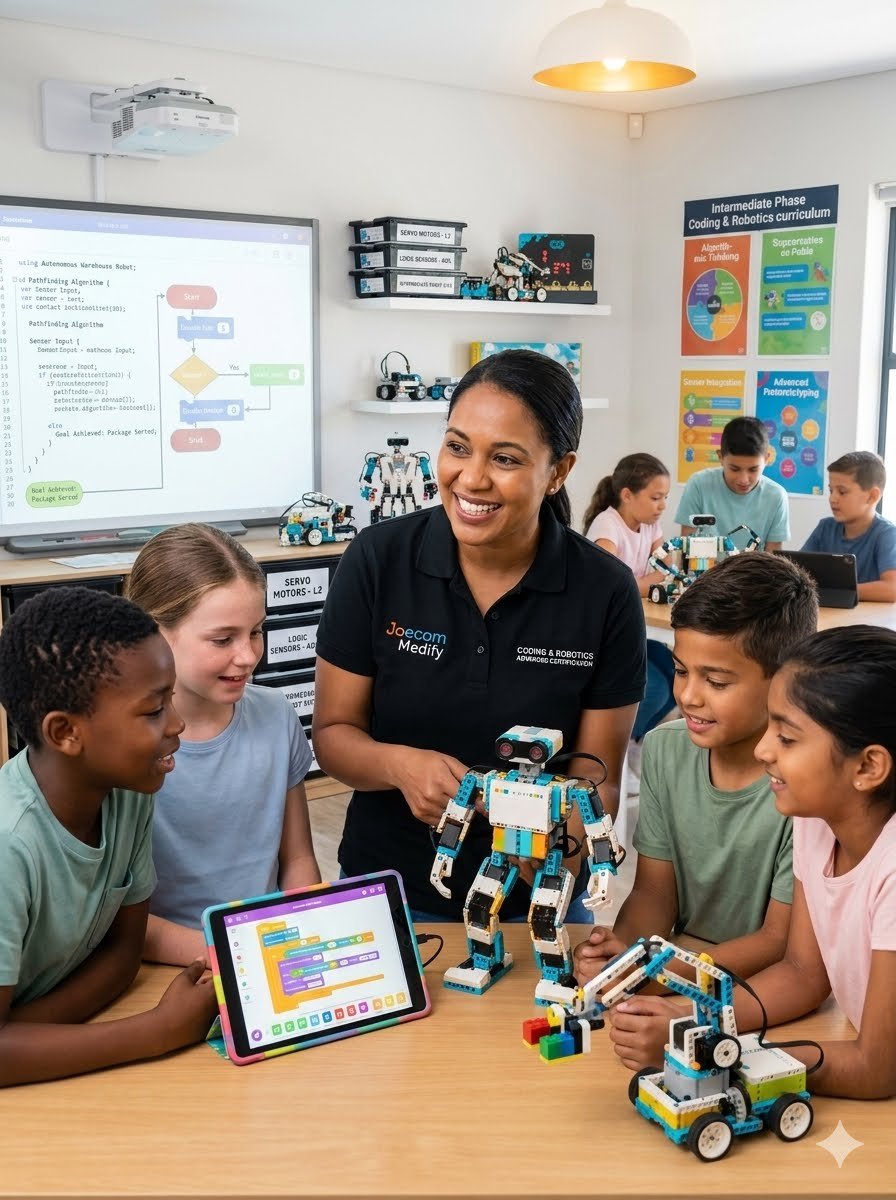
This practical course equips Intermediate Phase teachers with the knowledge, tools, and confidence to teach Coding and Robotics aligned with the Department of Basic Education CAPS curriculum.

Teachers will learn computational thinking, block-based coding, robotics integration, assessment strategies, and lesson planning for Grades 4–6 classrooms.

Course Highlights

  • Understand Computational Thinking in the Intermediate Phase
  • Teach sequencing, loops, conditionals, variables, and debugging Integrate robotics into CAPS-aligned lessons
  •  Use block-based platforms like Scratch
  •  Design unplugged coding activities
  • Create assessment rubrics and practical projects
  • Plan a full term Coding & Robotics programmes

What Will You Learn?

  • Understand coding fundamentals and computational thinking
  • Create programs using visual programming tools
  • Build and program basic robotics projects
  • Apply project-based learning in Coding & Robotics
  • Develop curriculum-aligned coding lessons
  • Design effective assessments and rubrics
  • Integrate coding and robotics across STEM subjects
  • Manage a digital coding classroom effectively
  • Foster creativity, collaboration, and critical thinking
  • Prepare learners for 21st-century digital skills

Course Content

Module 1: Introduction to Grade R Coding and Robotics
Welcome to **Introduction to Coding & Robotics in the Intermediate Phase. This module provides a strong foundation for teaching Coding and Robotics to learners in **Grades 4–6**. You will explore the purpose of Coding and Robotics in modern education, its importance within the **CAPS curriculum**, and how these subjects develop essential 21st-century skills such as computational thinking, creativity, collaboration, communication, and problem-solving. Throughout this module, you will become familiar with the key concepts of coding, algorithms, robotics, and computational thinking. You will also discover how Coding and Robotics can be integrated into everyday classroom teaching through engaging, learner-centered activities that encourage critical thinking and innovation. By the end of this module, you will be able to: * Explain what Coding and Robotics are and why they are important in the Intermediate Phase. * Understand the role of Coding and Robotics in the CAPS curriculum for Grades 4–6. * Identify the core concepts of computational thinking. * Recognize how coding and robotics support problem-solving, logical reasoning, and creativity. * Describe the benefits of integrating Coding and Robotics into classroom teaching. * Prepare learners for more advanced programming and robotics activities in later modules. This introductory module lays the foundation for the rest of the course, where you will learn practical coding techniques, block-based programming using Scratch, robotics integration, lesson planning, classroom assessment, and hands-on projects designed for Intermediate Phase learners.

  • Overview of Coding & Robotics Curriculum
  • Role of the teacher

Module 2: Computational Thinking Fundamentals
Goal: Understand the problem-solving process behind coding.

Module 3: Project-Based Learning in Coding & Robotics
In this module, you learned how to plan, manage, and deliver successful coding and robotics projects using a Project-Based Learning (PBL) approach. You explored how to design engaging term-long robotics projects that encourage students to apply coding, engineering, and problem-solving skills to real-world challenges. You also learned effective group project management techniques, including assigning roles, encouraging teamwork, and promoting collaboration throughout the project. Time planning strategies helped you understand how to break projects into manageable phases, set realistic milestones, and keep learners on schedule. The module emphasized creativity and innovation by encouraging students to brainstorm ideas, experiment with different solutions, and think critically when overcoming challenges. Finally, you discovered best practices for presenting projects professionally, including demonstrating robot functionality, explaining the design process, showcasing coding solutions, and communicating project outcomes with confidence. By the end of this module, you are equipped to guide learners through meaningful, hands-on robotics projects that develop technical knowledge alongside collaboration, creativity, communication, and critical thinking skills.

Module 4: Assessment & Moderation in Coding & Robotics
In this module, you learned how to plan, manage, and deliver successful coding and robotics projects using a Project-Based Learning (PBL) approach. You explored how to design engaging term-long robotics projects that encourage students to apply coding, engineering, and problem-solving skills to real-world challenges. You also learned effective group project management techniques, including assigning roles, encouraging teamwork, and promoting collaboration throughout the project. Time planning strategies helped you understand how to break projects into manageable phases, set realistic milestones, and keep learners on schedule. The module emphasized creativity and innovation by encouraging students to brainstorm ideas, experiment with different solutions, and think critically when overcoming challenges. Finally, you discovered best practices for presenting projects professionally, including demonstrating robot functionality, explaining the design process, showcasing coding solutions, and communicating project outcomes with confidence. By the end of this module, you are equipped to guide learners through meaningful, hands-on robotics projects that develop technical knowledge alongside collaboration, creativity, communication, and critical thinking skills.

Module 5: Integrating Coding Across Subjects
In this module, you explored how coding and robotics can be integrated across different subject areas to create engaging, cross-curricular learning experiences. You learned how coding activities can reinforce mathematical concepts such as patterns, sequences, measurement, logic, and problem-solving, making abstract ideas more interactive and meaningful. You also discovered how robotics can enhance Natural Sciences by allowing learners to investigate scientific principles through hands-on experiments, data collection, engineering design, and real-world applications. The module highlighted effective technology integration strategies, demonstrating how digital tools can support teaching, increase learner engagement, and foster collaboration. In addition, you learned how to develop STEM lesson plans that combine science, technology, engineering, and mathematics into practical, project-based activities aligned with curriculum outcomes. Finally, the module covered digital classroom management techniques, including organizing technology resources, promoting responsible digital citizenship, ensuring learner safety, and managing coding and robotics activities efficiently. By the end of this module, you are prepared to integrate coding and robotics into multiple subjects, creating innovative, student-centered learning experiences that strengthen both academic understanding and essential 21st-century skills.

Course Conclusion

Student Ratings & Reviews

No Review Yet
No Review Yet